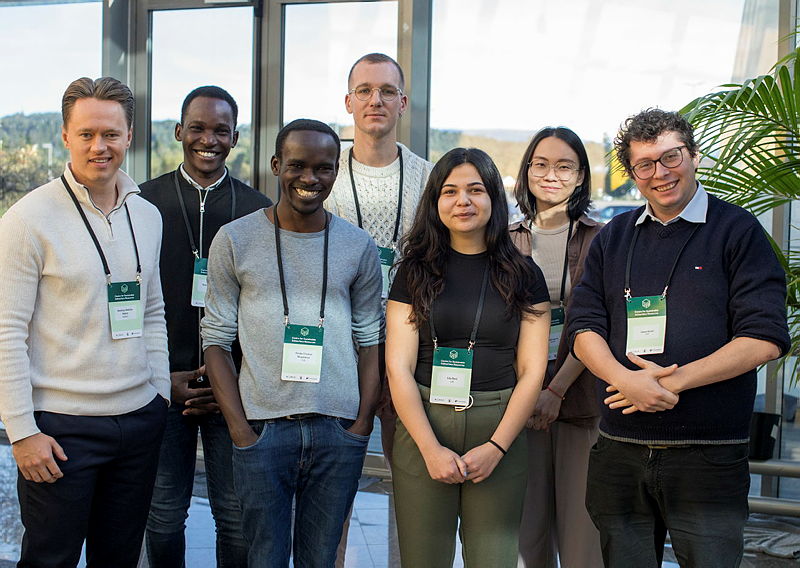
The 17th Greenhouse Gas Control Technology Conference (GHGT-17) represents the foremost international event focused on technologies for reducing greenhouse gas emissions, with a particular emphasis on carbon capture, utilization, and storage (CCUS). This esteemed conference series actively promotes low-carbon solutions to address climate change. Held in Calgary, Alberta, Canada, in October 2024, GHGT-17 gathered researchers, industry leaders, government officials, and business partners from around the world to explore pioneering technologies, innovations, and strategies for mitigating greenhouse gases. Among the attendees from NORCE were:
Alexey Khrulenko (WP6) presented an e-poster titled “Screening CO2 Storage Potential of Petroleum Reservoirs on the Norwegian Continental Shelf.” In his study, co-authored by Trine Solberg Mykkeltvedt(CSSR:WP6) and Sarah Gasda, he presented:
Methodology to assess and compare CO2 storage potential of Norwegian petroleum fields based on open data
A database with numerous screening parameters covering almost all Norwegian Continental Shelf (NCS) fields
A web app for data visualization and screening
Several application examples
One of the new analysis tools coming out from CSSR, presented at the GHGT, focuses on open-data CCS screening tools for depleted fields on the Norwegian continental shelf. Link to tool.
We have successfully wrapped up the final inter-comparison SPE11 workshop hosted by #CSSR, with 30 participants from around the world.
The early analyses of simulator comparisons sparked insightful discussions on lessons learned, ensuring openness and reproducibility, suggested methodologies, and, most importantly, future research directions. Stay tuned for the special session at the SPE Reservoir Simulation Conference in March 2025, and the release of the final paper.
A big thanks to the Comparative Solution Project(CSP) organizers:
The Computational Methods in Water Resources (CMWR), established in 1976, is held biennially, alternating between North America and Europe. It aims to advance interdisciplinary research in quantitative hydrological forecasting, focusing on mathematical, computational, statistical, and machine learning methods. The Conference took place from September 30 to October 3, 2024, in Tucson, Arizona.
Sarah Gasda, CSSR director is a keynote speaker at the CMWR conference.
Note: Featured picture from the organisers of CMWR.
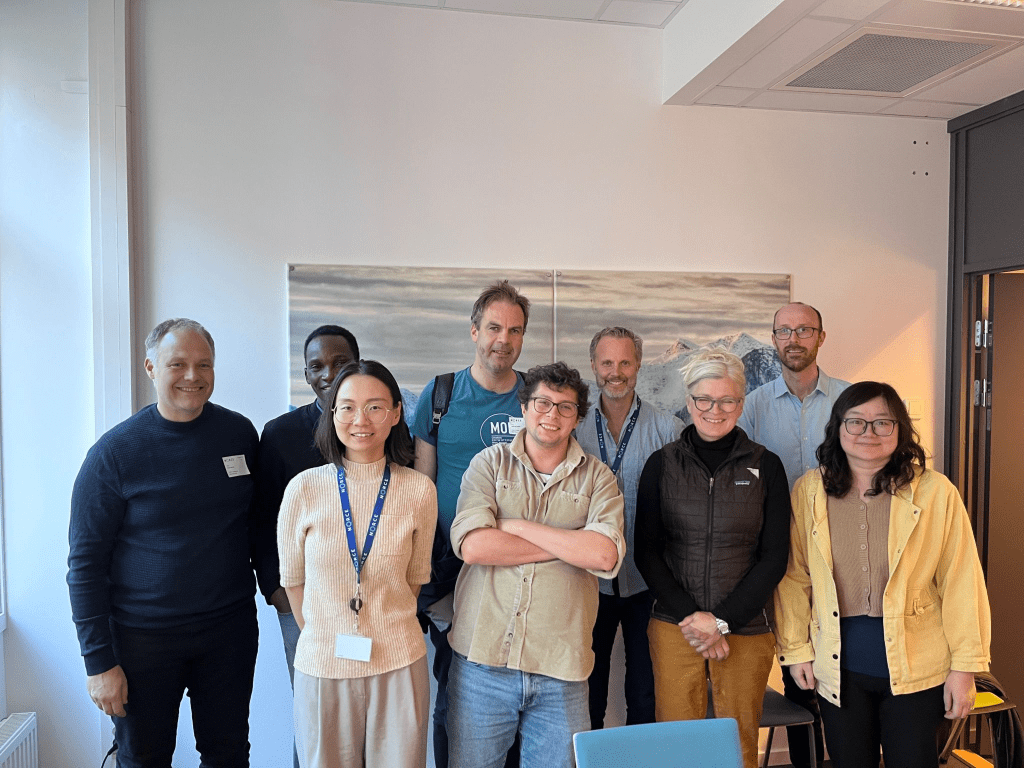
We are happy to inform you that Professor Dorthe Wildenschild from Oregon State University, one of our international partners, attended the annual meeting in Bergen. She also took the opportunity to participate in an internal workshop at NORCE on September 20, 2024.
The aim of the workshop was to strengthen our collaboration on the integration of experimental work and modeling activities. Among other topics, they discussed possible PhD student exchange opportunities in hydrogen and carbon storage applications:
During the workshop, participants discussed possible topics for PhD student exchange in hydrogen and carbon storage applications. Among the attendees were our PhD students, Tongtong Yu and Hasan Gürsel, who each presented a pitch about their work.
Dorthe Wildenschild has a PhD in environmental engineering, and her research is related to subsurface water pollution and energy-related storage challenges, focusing on flow and transport in porous media. Read more about her work here.
Picture from Sarah Gasda, participants from the workshop.
The CSSR annual conference was a success. Held at the Clarion Hotel, Bergen Airport, from September 18th to 19th, the event brought together nearly 100 participants, including leading international experts in sustainable subsurface research. Deputy Chair Ketil Djurhuus welcomed everyone, followed by opening remarks from recorded videos featuring Camilla Stoltenberg (CEO of NORCE), who couldn’t attend in person, Gunn Mangerud (Dean, UIB), and Kristin Margrethe Flornes (Executive Director, Energy and Technology).
(Photos: Rune Rolvsjord, NORCE )
Research Director Sarah Gasda showcased CSSR’s achievements and future potential, highlighting the centre’s impact. Geir Terje Eigestad, Chair of CSSR’s Executive Board, emphasized the critical role of academic-industry research partnerships. Ingrid Anne Munz from the Research Council of Norway discussed policies supporting energy transition and security.
A panel moderated by Ketil Djurhuus focused on the metrics of research success. Stressing the importance of making a tangible impact, Martin Blunt from Imperial College highlighted, “Collaboration with industry forces you to look at real problems. It keeps you grounded as a researcher.” Fredrik Varpe from Equinor and Tom Jonsthovel from SLB shared strategies for navigating the energy transition and leveraging digital technologies to de-risk CCUS.
Deputy Director Martin Fernø led an engaging session on poster presentations and fluid flow, featuring a live demonstration of the Fluid Flower by Jan Martin Nordbotten. PhD students excelled in pitching their research, including Hasan Gürsel (WP1), Antoine Lechevallier (WP4 Post-Doc), Eda Önal (Associated PhD), Mathias Nilsen(WP3), Raymond Mushabe(WP1); Kirabo Mugwanya Erismas(WP1), Tongtong yu(WP1). It was nice to see students from imperial college and CSSR presenting their work at the poster session. See below table for more information.
The conference featured an array of notable speakers who enriched the event with their expertise in various fields. Dorthe Wildenschild from Oregon State University delved into the intricacies of pore-scale flow characterization, offering attendees a deep dive into this complex area of research. Philip Ringrose from NTNU captivated the audience with his insights on CO2 flow and migration, shedding light on critical processes that impact both environmental and industrial applications. Dean Oliver from NORCE presented compelling strategies for optimizing CO2 emissions reduction, showcasing innovative solutions to one of today’s most pressing environmental challenges. Lastly, Gion Strobel from Uniper, Germany, shared valuable findings from hydrogen field tests, highlighting the potential and challenges of hydrogen as a clean energy source.
(Photos: Rune Rolvsjord, NORCE )
The second day of the conference was packed with insightful presentations. Mahad-Nadeem Janjua from Harbour Energy kicked off with a discussion on the role of AI in the energy sector. Guttorm Vigeland and Eric Toogood from the Norwegian Offshore Directorate discussed DISKOS 2.0 NDR, focusing on the availability and usability of offshore data. Dr. Rodolfo Oliviera and Dr. Eduardo Barros introduced the EVEREST open-source optimization tool, while Dr. Sergey Alyaev and Dr. Per Pettersson from NORCE explored geosteering and CO2 injection strategies. Further enriching the day, Professor Vahid Niasar from the University of Manchester presented on gas mixing in porous media. Dr. Ketil Djurhuus shared his expertise on particle-laden flows. Professor Ahmed H. Elsheikh from Heriot-Watt University discussed AI solutions for computational geosciences, and Yuri Zabegaev (PhD student at UoB) along with Tor Harald Sandve concluded with advanced simulation models.
(Photos: Rune Rolvsjord, NORCE )
Centre Director Sarah Gasda wrapped up the conference with an optimistic view of the future, underscoring the valuable discussions and collaborations that emerged. The event set the stage for another year of groundbreaking research and impactful discoveries. A big thank you to all participants for the important and engaging discussions!
The poster session, featuring students from Imperial College and CSSR among others, was an incredibly engaging event.
Poster session
Presenter
Title
Institution
Alexey Khrulenko (Researcher at NORCE, WP6)
Screening CO2 storage potential of petroleum reservoirs on the NCS using openly available data
CSSR
Antoine Lechevallier(PostDoc)
Data-driven non-linear preconditioning for the acceleration of well events handling in the numerical simulation of CO2 storage
CSSR
Eda Önal
Coupling strategies in large-scale simulations of CO2 storage
CSSR
Hasan Gürsel
Phenomenological Modeling of Produced Water Transport in Porous Media
CSSR
Kirabo Erismas Mugwanya
Triassic sedimentary geometries and reservoir heterogeneity of the Horda Platform, northern North Sea
CSSR
Mathias Nilsen
Wind-powered Reservoir Management
CSSR
Peter Schultzendroff
Adaptive homotopy continuation method to recover robustness of hybrid models
CSSR
Raymond Mushabe
Combining traditional methods and the state-of-the-art MRI-PET imaging to extract the kinetics of microbial hydrogen consumption in porous media at a core scale.
CSSR
Tongtong Yu
Intermittent Multiphase Fluid Flow in Porous Media and the Effect on Injectivity and Reservoir Performance
CSSR
Ademola Adebimpe
Percolation without Trapping: How Ostwald Ripening during Two-Phase Displacement in Porous Media Alters Capillary Pressure and Relative Permeability
Imperial College
Ahmed AlZaabi
Pore Occupancy, Connectivity and Ostwald Ripening of Nitrogen, Carbon Dioxide, and Hydrogen in Carbonate Rocks: A comparative study
Imperial College
Ibrahim Alobaidan
Numerical Simulation of Hysteresis Effects on Underground Hydrogen Storage in Aquifers
Imperial College
Olatunbosun Adedipe
Impact of Mineral Spatial Distribution on CO2 Dissolution Rates in Multimineral Carbonate Rocks
Imperial College
Sajjad Foroughi
Multi-Scale Pore Network Modeling of Multiphase Flow in Micro-Porous Complex Rocks
Imperial College
Si Suo
Numerical modelling of Non-Newtonian fluid flows in porous media
Stephan Matthai , our SAC member (Scientific Advisory Commitee) who came for the CSSR annual conference , took the opportunity to visit NORCE prior to the conference. He is based in Australia from the University of Melbourne . Our researchers David Landa Marbán and Tor Harald Sandve met with him and discuss several technical topics related to subsurface engineering and simulation:
SPE11 Benchmark: They explored the SPE11 Comparative Solution Project, a benchmark used to evaluate simulation tools’ accuracy in subsurface flow modeling, particularly in CO2 storage scenarios. This ensures that the simulators effectively model complex reservoir behaviors.
CSP3D3.0 Simulator: Stephan highlighted updates to CSP3D3.0, his advanced simulation platform. This tool is instrumental in simulating fluid flow through complex, fractured subsurface environments.
OPM Flow: They discussed the features and future roadmap of OPM Flow, an open-source simulator used for various reservoir simulations, including CO2 storage and geothermal energy applications. OPM Flow is valued for its flexibility, supporting a wide range of geological and fluid systems.
CO2 Geothermal Applications: The conversation included potential innovations in using CO2 for geothermal energy extraction. This approach leverages CO2’s dual purpose—carbon storage and energy transfer, contributing to both climate goals and energy production(OPM Project).
This meeting marked an important step in their collaborative work, advancing simulation capabilities for energy and environmental projects.
The ECMOR Conference 2024, held from September 2-5 in Oslo, marked the 19th European Conference on the Mathematics of Geological Reservoirs. The event centered on the pivotal role of mathematical modeling and subsurface simulation in developing solutions to meet the United Nations Sustainable Development Goals (SDG 7): “Affordable and Clean Energy” and SDG 13: “Climate Action.” Numerous representatives from NORCE were in attendance.
Photos by Sarah Gasda.
NORCE/CSSR Participation at ECMOR 2024:
Sarah Gasda
Understanding Regional Multi-Site Storage Systems
Kristian Fossum
Advancing Subsurface Uncertainty Quantification with multilevel Bayesian model comparison
Birane Kane
Machine learning-based HP-Adaptive Discontinuous Galerkin Methods for Multiphase Flow in Porous Media
Xiaodong Luo
Cross-validation in an iterative ensemble smoother: Stopping earlier for better.
Mathias Methlie Nilsen
Wind-powered Reservoir Management
Trine S. Mykkeltvedt
Efficient computational approaches to quantify hydrogen leakage through faults in underground hydrogen storage
Per Pettersson
Multi-objective optimization for multi-agent injection strategies in subsurface CO2 storage
Tor Harald Sandve
Closed-loop reservoir management using fast data-calibrated coarse models
Sergey Alyaev
Distinguish workflow: a new paradigm of dynamic well placement using generative machine learning
We are delighted to welcome Pit Arnold as our new Technical Advisory Committee (TAC) chair from September 2024, succeeding Geir Terje Eigestad. We express our heartfelt gratitude to Geir for his outstanding contributions as TAC chair since its inception. Pit joined the CSSR as a member of the TAC in 2024 and currently serves as TAC chairman. Joining Pit as the new deputy is Bastian Koehrer. He joined the CSSR as a Member of the TAC in 2023 and currently acts as TAC Deputy Chair.
Pit Arnold is a Simulation Engineer Digital Rocks, who holds a PhD in Petroleum Engineering. He joined Harbour Energy in 2023 as part of the Digital Rocks team at their Technology and Service Center in Germany. His research interests are pore scale physics in porous media, particularly in the areas of multiphase flow modeling and multiscale imaging. In addition to his role at Harbour Energy, he serves as a visiting lecturer at the Montanuniversität in Leoben.
Bastian Köhrer is a Subsurface Manager with Harbour Energy in Stavanger, Norway. He has over 17 years of upstream oil and gas industry experience with assignments in Germany, Norway, Oman and Qatar. He obtained a PhD in Geology from the University of Tübingen, Germany, with a carbonate sedimentological study on the Middle Eastern Khuff Formation in collaboration with Shell and Petroleum Development Oman. His R&D interests are within reservoir characterization and modelling of particularly carbonate and tight reservoirs, an area in which he is a recognized technical authority, documented by an EAGE Distinguished Lecturer nomination (2015/16), numerous publications (h-index: 17) and a significant record of peer reviewing for esteemed scientific journals. Bastian currently serves as House of Delegate Member for the American Association of Petroleum Geologists.
Offshore Northern Seas (ONS) stands as one of the premier global events for the international energy industry. The ONS Conference 2024, which took place from August 26-29 in Stavanger, was a major event for the global energy sector. With the theme “Imagine,” the conference inspired participants to delve into innovative ideas and reimagine the future of energy. Critical discussions covered essential topics, including energy, security, finance, and policy.
NORCE, in collaboration with Energy Transition Norway, hosted a debate and had a booth at the event. The discussion focused on “How can we achieve a profitable, sustainable, rapid, and fair energy transition?”. Sarah Gasda, CSSR Director attended the event, keen to discover how companies, including our #CSSR partners, are addressing the energy transition.
Picture from NORCE: (From left) Ying Guo, Thor Arne Håverstad, Peter Breuhaus og Sarah Gasda, at the NORCE stand in ONS 2022
The ECCOMAS 2024 conference, held in Lisbon, Portugal from 3rd-7th June, was a premier event for scientists and engineers specializing in computational methods in applied sciences and engineering. The conference featured nearly 2600 presentations, including 8 plenary lectures, 20 semi-plenary lectures, and 75 keynote lectures, spread across 188 minisymposia and 15 special technical sessions.
Researchers from CSSR made notable contributions. Dr. Jakub Both organized and chaired a session on efficient simulation technology for multiphysics in complex porous media. Dr. Eirik Keilegavlen presented their work on automatic solver selection for multiphysics porous-media numerical simulations. Their presentations highlighted CSSR’s leading role in advancing computational modeling and simulation technologies, particularly in the study of porous media.
Papers with CSSR/NORCE/UiB involvement:
PoroTwin: Digital twins and machine learning for laboratory-scale porous media. E. Keilegavlen, E. Fonn, K. Johanessen, K. Eikehaug, J. Both, M. Fernø, T. Kvamsdal, A. Rasheed, J. Nordbotten
Two view points on numerical simulation of porous media. J. Both, T. Dagli
Nonlinear solution of frictional contact poromechanics. J. Both, M. Nevland, E. Keilegavlen, I. Berre
A machine learned near-well model in OPM. P. von Schultzendorff, J. Both, J. Nordbotten, T. Sandve, B. Kane, D. Marban