
In 2025, CSSR launched a monthly Open Webinar Series to strengthen scientific exchange and make research from across the centre more accessible. The series offers a regular forum for researchers at all career stages to present ongoing work, share new findings, and receive feedback from colleagues within and beyond the consortium. Opening the webinars to national and international participants has broadened CSSR’s academic reach, increased visibility for early‑career researchers, and supported interdisciplinary dialogue. The series is now a stable part of CSSR’s research culture, promoting transparency and linking subsurface research with emerging needs in the energy transition.

Underground hydrogen storage: Midway insights from the HyDRA project
Martin Fernø | UiB
This webinar examines the latest findings from the HyDRA project on underground hydrogen storage, focusing on how microorganisms, rocks and formation waters interact with stored hydrogen. The results provide valuable insights for identifying suitable storage sites and managing potential risks associated with underground hydrogen storage.

Verena Nikeleit | NORCE
This webinar examines how underground microorganisms interact with hydrogen storage systems and how reservoir geology and mineral composition can influence microbial activity. The findings provide valuable insights for assessing and managing potential risks associated with underground hydrogen storage.

Making Your Research FAIR in Practice: An Introduction to GitHub/cssr-tools
David Landa-Marbán | NORCE
This webinar focuses on the practical implementation of FAIR principles in scientific software and computational research workflows, highlighting how open, reproducible, and reusable approaches can support collaboration, transparency, and innovation in subsurface research.

Kirabo Erismas Mugwanya | UiB
This webinar focuses on research exploring the evolution and CO₂ storage potential of Triassic reservoirs on the Horda Platform, highlighting how fault-controlled basin development influences sedimentation, reservoir geometry, and storage performance.

Na Liu | UiB
This webinar presents recent research on the use of microfluidic pore‑scale models to investigate hydrogen transport, mineral reactions and microbial activity in subsurface systems, with direct relevance for underground hydrogen storage and subsurface energy applications

From Pores to Cores: How Flow Interruptions Shape Particle Deposition
Tongtong Yu | NORCE
This webinar presents PhD research on particle transport and retention in porous media, with direct relevance for produced water reinjection in oil and gas reservoirs. Produced water contains solid particles, oil droplets, salts and other contaminants that may reduce injectivity through particle deposition and filter cake formation. The study combined core‑scale and pore‑scale experiments to investigate how injection strategy and pore structure affect injectivity decline.

Data‑Integrated Modelling and Image‑Based Analysis of Multiphase Flow in Porous Media
Jakub Both | UiB
The webinar presents recent advances in bridging the gap between laboratory experiments and computational modelling to improve our understanding of CO₂ storage processes. Dr. Both’s work focuses on creating a robust interface between experimental observations, quantitative data extraction and physics based simulations

Digital Rock Methods for Multiphase Fluid Flows
Espen Jettestuen | NORCE
The webinar presents a new digital method for understanding how fluids flow through rocks deep underground. By using detailed 3D images of real rock samples, the team uses pore-scale simulation to model fluid flow of two and three phases. The method can complement traditional laboratory experiments and offers new possibilities for studying complex behaviour that is otherwise difficult to observe directly.
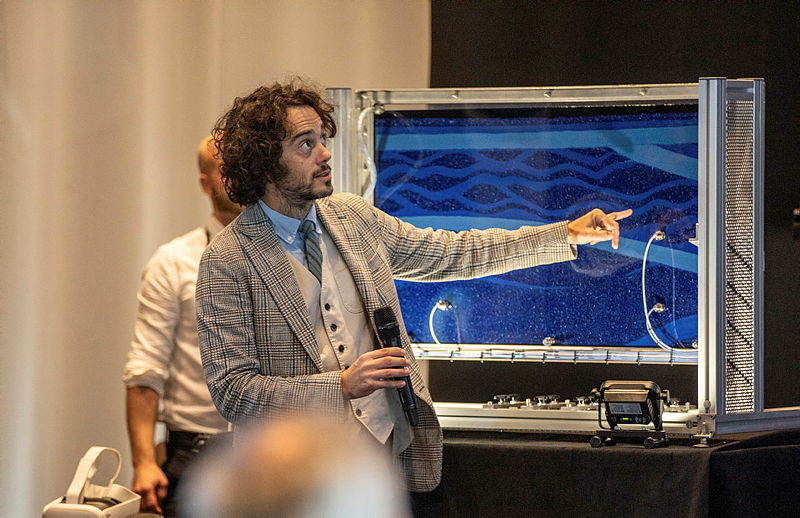
InterPore webinar: Understanding data and simulations for flows in porous media
Jan Martin Nordbotten | UiB
CSSR hosted an InterPore webinar given by Professor Nordbotten. In this webinar, you will learn about: digital twins and data integration; verification and validation of model predictions; methods for intercomparison of data and experiments.

Antoine Lechevallier | NORCE
Reservoir simulation guide decisions on field development and resource management, but they are computationally demanding and often slowed down by nonlinear solver failures. The webinar presents latest research based on Hybrid Newton, a machine learning–enhanced approach that learns from previous runs and predicts a better initial guess for the Newton solver. The result is fewer nonlinear solver failures and improved simulator performance.

Underground hydrogen storage in porous media: Microbial controls and multiphase flow
Raymond Mushabe | UiB
This webinar describes how microbes living in saline water within reservoir rocks may influence hydrogen storage and recovery. The presented research combines laboratory experiments, imaging techniques, and computational models to improve underground hydrogen storage efficiency and support the development of reliable clean energy systems.

Closed-loop workflow for short-term optimisation of wind-powered reservoir management
Mathias Methlie Nilsen | NORCE
This webinar explains how offshore operations can shift more of their energy use to wind power by using wind forecasts in their planning. A novel workflow is demonstrated that adjusts pumping and production schedules depending on how much wind power is expected each day. The results show that emissions can be noticeably reduced, even when the wind varies, and production can still be maintained at stable levels.

CO₂ Storage Potential on the Norwegian Continental Shelf
Trine Solberg Mykkeltvedt | NORCE
This webinar presents a new screening tool designed to evaluate the CO₂ storage potential of depleted hydrocarbon fields on the Norwegian continental shelf (NCS). Built on publicly available data, the tool offers an interactive way to assess indicators for properties like storage capacity, injectivity, and field expected lifetime across 134 hydrocarbon fields. With open access to the data and code, this tool enables researchers, policymakers, and industry stakeholders to do an early stage screening for CO₂ storage candidates on the NCS.