Four papers at SPE Norway Subsurface

CSSR researchers will present four papers at the upcoming SPE Norway Subsurface Conference to be held in Bergen on April 17, 2024. The annual event is Norway’s Only Dedicated Event Addressing Well, Drilling, Completion and Reservoir Management Issues.

The papers reflect CSSR’s efforts to advance new digitalization methods to aid and assist management workflows and to study complex processes within petroleum reservoirs and CO2 storage. The papers explore the use of digital rock physics, machine learning and advanced CO2 storage simulation, spanning multiple scales, from pore- to near-well to field.


Workflow for Direct Pore-scale Simulation of Relative Permeability and Capillary Pressure Curves with Hysteresis at Low Capillary Numbers

Authors: E. Jettestuen, O. Aursjø, J.O. Helland, L. Vinningland, A. Hiorth

Session: 10 Reservoir IV

Summary; To develop an efficient and consistent numerical method to estimate relative permeability and capillary pressure curves directly from pore-scale images. Here we propose to use a single-phase flow solver to obtain relative permeabilities from static two-phase configurations, in order to mitigate effects of traditional methods that suffers from boundary effects and poor numerical resolution of phase interfaces.

Data-Driven Predictions of COEOR Numerical Studies Using Machine Learning in An Open-Source Framework

Authors: J.R. Lliguizaca (UiB); D. Landa-Marbán (NORCE), S.E. Gasda (NORCE), T.H. Sandve (NORCE); Z.P. Alcorn (UiB)

Session: 10 Reservoir IV

Summary: An evaluation of machine learning (ML) assisted carbon dioxide (CO2) enhanced oil recovery (EOR) and CO2 retention predictions during water-alternating-gas (WAG) injection is presented, using an open-source framework implemented combining reservoir simulation to determine the objective values, which subsequently were used to train and test the supervised learning algorithms. The objective is to increase the speed, robustness, and accuracy of oil recovery and CO2 retention numerical estimates using open-source solutions and ML techniques.

Impact of Intermittency on Salt Precipitation During Co2 Injection

Authors: D. Landa-Marbán, N. Zamani, T.H. Sandve, S.E. Gasda

Session: ePoster II

Summary: In this paper, we study the effect of different parameters such as injection rate and capillary pressure on salt precipitation and CO2 propagation within the reservoir. The results of this study provide insight into the design and management of CO2 storage projects.

Regional CO2 Storage Simulations on the Troll Aquifer Model

Authors: S. Tveit, S. Gasda, D. Landa-Marbán, T.H. Sandve

Session: Subsurface Contributions to Energy Transition

Summary: Simulations of multi-site CO2 storage operations in the regional Troll Aquifer model is presented. An assessment of regional pressure and plume developments, and multi-site CO2 allocation will be shown.


Don’t miss out on other exciting contributions in our sister projects!

A Digital Twin for Reservoir Simulation

E. Keilegavlen, Department of Mathematics, University of Bergen; E. Fonn, K. Johannessen, T. Tegnander, SINTEF Digital; K. Eikehaug, Department of Physics and Technology, University of Bergen; J. Both, Department of Mathematics, University of Bergen; M.A. Fernø, Department of Physics and Technology, University of Bergen; T. Kvamsdal, A. Rasheed, SINTEF Digital/Norwegian University of Science and Technology; G. Eigestad, Wintershall DEA Norge; J.M. Nordbotten, Department of Mathematics, University of Bergen

Investigation of Synergy Between Extended Oil Recovery and Hydrogen Storage in a Producing Field Using the Norne Reservoir Model

Authors: B. Amiri, P.Ø. Andersen, M. Ghaedi, University of Stavanger; X. Luo, NORCE Norwegian Research Centre

SPE11: More than 40 confirmed participants

The deadline for submitting participation agreements for SPE11 has now passed, and we are very excited to see that more than 40 teams have signed up! These include all relevant sectors, and are spread across the globe. 

Two of the study leads, Professors J. M. Nordbotten and Martin Fernø, are Focus Area Leads and deputy directors of CSSR.

The 46 participants from all corners of the world will be working on their solutions through 2024, with final results due to be submitted in September. After spending the winter analyzing the submissions, the conclusions of the study are expected to be presented at the 2025 SPE Reservoir Simulation Conference. Further details on the study can be found at spe.org/csp.

We are extremely honored to see the
response our SPE11 description has received
in the community and are thankful to all the research groups that have chosen to prioritize time and resources to participate in the study. 46 participating groups is beyond any of our expectations and is by far a record for any
SPE comparative solution project and promises to make the SPE11 a milestone within computational simulation of geological

carbon storage.

Jan Martin Nordbotten, CSSR centre deputy
Photo: Martin Fernø, Lluis Saló-Salgado and Jan Martin Nordbotten

Background

The 11th Society of Petroleum Engineers (SPE) comparative solution project (known
as the SPE11), was launched in 2023 at the SPE Reservoir Simulation Conference. The study consists of three datasets built around a common geometry, and is motivated by
the simulation challenges associated with CO2 storage operations in geological settings typical of the Norwegian continental shelf.

During the development of SPE11, three CSSR partners – NORCE, SLB and Stuttgart University – were involved in the quality control and the testing of the datasets. This pre-launch process allowed reservoir simulation groups from academia and industry to provide feedback on the simulation challenges involved in the SPE11.

FluidFlower experiment on YouTube

The FluidFlower experiment is a powerful experimental and communication tool — making visible what no one has ever seen before. A new video explains what happens to CO2 stored deep below the ocean’s surface. CSSR centre deputies Martin Fernø (UiB/NORCE) and Jan Martin Nordbotten (UiB/NORCE) explain the context of the experiments.

The video was produced by Wintershall Dea, an industry partner in CSSR.

CSSR @ SIAM Geosciences Conference 2023

June 19 – 22, the SIAM Conference on Mathematical & Computational Issues in the Geoscience (GS23) was held in Bergen. The conference was co-chaired by CSSR deputy director Jan Martin Nordbotten. In the Local Organizing Committee, we also recognize many others from the CSSR team: Sarah Gasda, Eirik Keilegavlen and Jakub Both. 

The conference had 350 registered participants from the whole geoscience’s community. At the first day, the FluidFlower experimental rig was in the center of attention both in the icebreaker in the evening, and during several concurrent sessions. During the icebreaker Jan Nordbotten announced the first ever live experiment at a conference venue, as CO2 was injected in the FluidFlower in front of engaged participants! Our partner Wintershall Dea sponsored part of the icebreaker.  

Throughout the week, the CSSR team participated in organizing 4 mini-symposiums, contributed to 15 scientific talks, presented posters, and promoted some of the research being done in our Centre. In addition, all our international partners represented by collogues from Imperial College London, Oregon State University, Stuttgart University, TNO, and TU Delft, contributed to the program. 

The conference demonstrated that the FluidFlower experimental has become an arena for international verification of geological carbon storage simulation capabilities. In addition, much of the centers dedicated research on advanced methods for data-driven modeling in porous media applications was presented through the work of Birane Kane, Jakub Both, Eirik Keilegavlen and others. Our PhD student Peter von Schultzendorff gave a very interesting talk onTwo-Phase Flow with a Data-Driven Flux Mode.  

The CSSR team was particularly visible in the mini-symposium on Testing Predictive Capabilities of Geologic CO2 Storage with Meter-Scale Laboratory Experiments, organized by CSSR deputy directors Martin Fernø and Jan Nordbotten. In the same mini-symposium, results from David Landa-Marban on An Open-Source Image-Based History Matching Framework for the FluidFlower Data Set was presented. The CSSR team was also co-organizing a mini symposium on Developing Complex Simulation software, which cumulated in an interesting panel debate where Tor Harald Sandve participated.  

On Tuesday many of the delegates attended an exciting excursion to the Northern Lights CCS site in Øygarden. The conference-dinner on Wednesday was held in the spectacular venue at the Aquarium in Bergen. Overall, an inspiring week with many scientific discussions and highlights.  

Photos by Trine Mykeltvedt and Sergey Alyaev 

New paper in Physics of Fluids selected as Editor’s pick

Digital rock physics has been in use for the last 30 years as a method to extract petro-physical properties from digital scans of reservoir rocks or reservoir rocks analogs. This is a multi-stage process that includes collection of representative samples, digitalization of the rock’s pore space and numerical simulations of the physical properties we want to study.

One challenge, from the numerical simulation perspective, is that simulating how fluid flows inside the rock is very computational demanding, so that we want to use fast fluid solvers. A problem with these solvers for intermittent flooding scenarios is that they exaggerate compressible effects in fluid simulations for complex geometries, like porous media, and can even induce spurious acoustic phenomena.

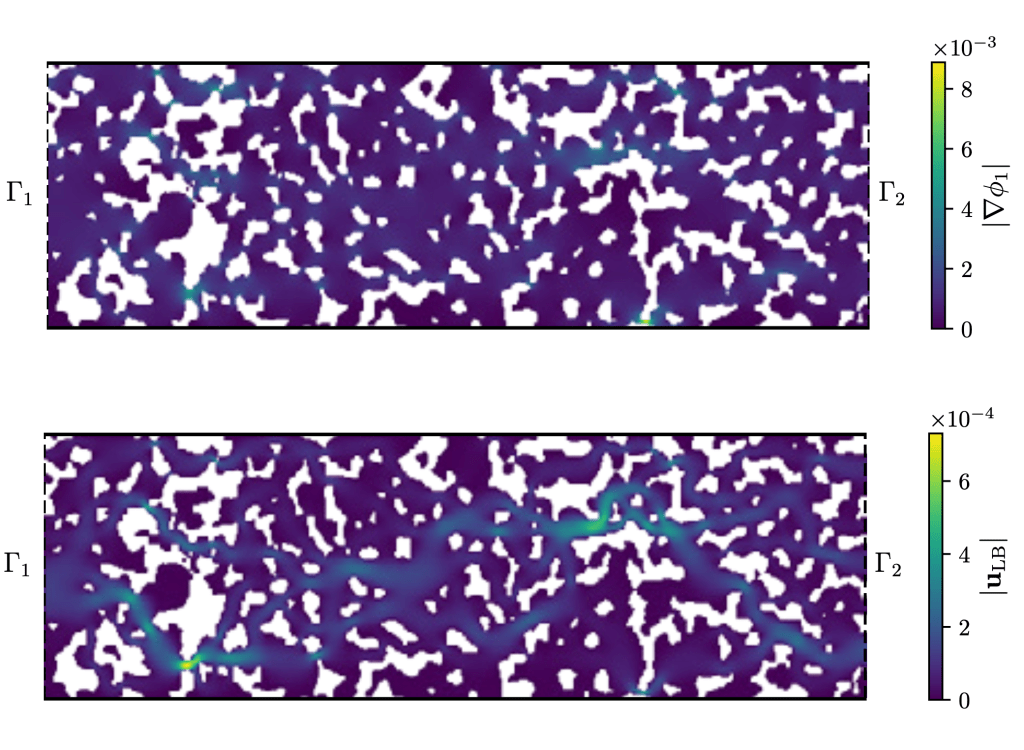
The top subfigure shows the magnitude of a force field representing a pressure driven flow. Note how the force magnitude adapts to the pore geometry. The bottom subfigure shows the associated velocity field.

A standard method to remove these unwanted effects is to use an implicit numerical solver, which is the natural choice for stationary problems. However, for dynamic systems, where boundary pressures and/or fluxes change rapidly, implicit solvers can impose a heavy computational burden.

In the article “A generalized bodyforce scheme for lattice Boltzmann simulations of incompressible flow in complex geometries” we describe a faster method for solving incompressible multi-phase fluid flow problems, which works well within CSSR’s focus on intermittent flooding scenarios.

Lead author, Espen Jettestuen (WP1 leader)

Our method is a generalization of the well-established forcing method, which is used to induce flow where the inlet and outlet are positioned opposite of each other in a regular computational domain. In this paper, we show that our method performs well for general complex geometries with multiple open boundaries. We also show that our method improves the simulation of systems where the standard forcing scheme is applicable. The only increase in computational time is during the initialization step, so there are no additional costs at run-time.


Jettestuen, Espen; Aursjø, Olav; Vinningland, Jan Ludvig; Hiorth, Aksel. A generalized bodyforce scheme for lattice Boltzmann simulations of incompressible flow in complex geometries. Physics of Fluids, 35, (2023).

Seven papers submitted to Transport in Porous Media on the FluidFlower International Benchmark study

Over the last 2 years, CSSR deputy directors Martin Fernø (UiB/NORCE) and Jan Martin Nordbotten (UiB/NORCE), together with their research groups, have worked on developing the FluidFlower experimental rig to become an arena for international verification of geological carbon storage simulation capabilities.

This work is now culminating in a special issue of the journal Transport in Porous Media, with 15 contributed papers currently under review from around the world. The CSSR team is involved in seven of these papers, including the centerpieces of the effort. The interdisciplinary collaborative effort is a double-blind forecasting and validation study, where nine academic research groups active in numerical simulation of carbon storage from around the world forecasted the outcome of a carefully curated carbon storage operation in the FluidFlower (Flemisch et al.). The forecasting and validation study is made possible through a suite of laboratory work, involving petrophysical characterization and experiments, documented in detail to be available as a resource for carbon storage modelers worldwide (Fernø et al.). To bridge the gap between laboratory measurements and simulation technology required the development of DarSIA, a dedicated image analysis toolbox for porous media which has been released open-source (Nordbotten et al.).

Representative figure of results submitted by benchmark participants, described further in Flemish et al. The panels show spatial distribution of CO2 concentration in the liquid phase after 48 h. Red color indicates a maximum in dissolved CO2 concentration, while blue indicates absence of dissolved CO2.

The core papers mentioned above are supported by additional papers on the experimental methodology (Eikehaug et al.), detailed supporting experimental data (Haugen et al.) and the value of field-pilot type training data for operational forecasting (Saló-Salgado et al.). The final piece of the puzzle is showing how the learnings at the lab scale translate to the field scale, as analyzed by Tony Kovscek of Stanford University, who spent his sabbatical visiting Bergen during the fall of 2022 (Kovscek et al.).  

Timely review of subsurface carbon storage

A new review is published on subsurface CO2 and H2 storage: ‘Subsurface carbon dioxide & hydrogen storage for a sustainable energy future‘ from Krevor et al., in Nature Reviews Earth & Environment.. This is a forward looking review where we evaluate the feasibility of expanding subsurface CO2 storage into a global-scale business, and translate lessons to H2 storage.  

Article for download: https://lnkd.in/egr7z8PQ
And freely available to read: https://rdcu.be/c3LE5

CCS is poised for widespread deployment, and it will happen fast if we have any chance of tracking IPCC pathways. What’s the hold-up? CO2 storage capacity has historically lagged behind capture capacity by 7-10 years. 96% of the worldwide storage potential is undiscovered. For Europe that translates to 172 Gt of storage waiting to be developed. There are no technical showstoppers here. Industry and research need to work together to make more headway on assessment of new storage sites. 

The paper provides an overview on:

➡ CCS Monitoring Technologies
➡ CCS Business Models 
➡ Analogies and Differences between CCS and Hydrogen
➡ The importance of social licenses to operate these technologies
➡ Ways for communities & governments to work together

Contributions by CSSR researchers: Sarah Gasda (NORCE) and Hadi Hajibeygi (TU Delft).

Expert interview of CSSR director

The news agency Deutsche Welle (DW) was in Norway covering the official opening of the Northern Lights visitors centre and stopped by NORCE to hear the perspectives of carbon storage experts on how CCS can help reduce emissions safely and effectively. The reporters viewed new simulation results of the FluidFlower study also took a tour of the lab where CO2 storage experiments are conducted.

Watch the video report to hear excerpts of the expert interview with Sarah Gasda, CSSR director. Many thanks to Ketil Djurhuus, Morten Aara and David Landa Marban for supporting the site visit.

Date: November 15, 2022

Reporter: Max Zander, DW

Original story link

Vestland CCUS 2022

The annual seminar gathers representatives from research, academia, industry and the public sector from the greater Bergen region. A diverse and exciting two-day program highlighted cutting edge research and industrial innovations that will help accelerate deployment of CCUS technology in western Norway. Participants also had the unique opportunity to visit the Northern Lights site and hear the latest updates of the groundbreaking project.

The main message from participants is despite tremendous progress in recent years, time is running out! We need to move fast, we need to work together, and we need to innovate to reduce costs.

Group photo at Northern Lights visitor’s center. Photo credit: Veronica Helle, NORCE

The seminar was organized by NORCE and University of Bergen (UiB) in collaboration with Energiomstilling Vest, Grøn Region Vestland, Øygarden næringsutvikling KFGassnova SF og Bergen kommune. Read more on LinkedIn https://www.linkedin.com/feed/update/urn:li:activity:7001834278216962048/